Songs of the South

Maggie by my Side Lyrics-cropped
Lyrics to “Maggie by my Side,” written in C.W. Holbrook’s Civil War diary.

There are lyrics to 17 songs written in C.W. Holbrook’s diary. They were written down by various hands, none of them Holbrook’s. Who all these music lovers were is a mystery, probably one lost to history.

Some of the songs written in the diary were composed long before the Civil War, others in the following decade. The wonderfully titled ballad “I’ll Be No Submissive Wife” was composed by Alexander Lee in antebellum 1838, while “Write A Letter From Home,” by William Shakespeare Hays, was composed in 1867, after the war.

It appears some of the songs were written in the diary during the war, including two versions of “Root Hog or Die,” which was both a popular song and saying of the day.

Root Hog or Die - Louisiana Sign
Husband John and I saw this sign last year in Louisiana.

The catch-phrase “Root Hog or Die” had been around for decades and had to do with self-sufficiency. Both Union and Confederate troops sang the “Root Hog or Die” song.

Southerners were fond of a version that incorporated Abe Lincoln, who was apparently so unpopular with Texans he didn’t even make the ballot for the 1860 presidential election.

Sometimes, the song was customized for a particular unit. A version of “Root Abe or Die” written in the diary and attributed to “Texas Ranger – Dr. Frazier” goes like this:

The Lone Star Defenders a gallant little band
On the tenth of June left their native land
To defend their Country away they all did hie
They go it in the Sun or Shade “Root Hog or die” 

Hurrah boys Hurrah, we Rangers know our rights
And if they trample on our toes we make them see sights 

Chorus
The Lyon ceased to roar and Siegel on the shy
Big Abe little Abe root Abe or die 

Twas at the town of Dallas, we all did concentrate
And formed into a Regiment within our native State
Then with our brave commander, we bid our friends good-bye
And Started North to make the Dutch “Root Abe or die” 

Twas on the fourth of August we reached McCulluch’s camp
And there we stopped a day and night to trim and light our [illegible]
The Southern boys united here and on each one would cry
To morrow boys we’ll make em get “Root Hog or die” 

Then on the fifth we started to hunt the Lyon’s den
Between our camps and Springfield we thought we’d find his men
But when they learned that Greer and his Rangers were so nigh
The Dutch though it time for them to “Root Hog or die” 

McCulluch pitched his camps about ten miles from town
And there on Wilson’s Creek we secured the country round
But we couldn’t catch them out from town and I’ll tell you the reason why
They knew the Southern boys would make them “Root Hog or die” 

Twas on the tenth of August we heard the Lyon roar
[illegible] among our boys the grape and Shell did pour
[illegible] opted to surprise us and take us on the sly
But he found that Southern boys didnt “Root Hog or die” 

He told us his lovely Soldiers to whip the South they must
But e’er he saw that triumph he had to bite the dust
His brave and noble deeds were done and I’ll tell you the reason why
Because the “Hogs” could’nt “Root” and of course he had to die 

When Woodruff’s well known battery like thunder peels did roar
It made old Siegel tremble for he’d heard its voice before
He heard it down at Carthage and to take it he did try
But he with his brethren had to “Root Hog or die” 

This great Siegel fought us bravely for two long hours or more
And then his fine Artillery had to cease its roar
For when the Rangers charged him he knew he had to fly
And through a field of corn we made him “Root Hog or die” 

Montgomery’s men in Kansas are getting very bold
There was a regiment of them on the field as we have been told
To whip the “Texas Rangers” they were anxious here to try
One third of them was left to “root” and the ballance had to die 

Now if Old Abe’s not satisfied and wants to fight again
All he has to do is muster up his men
To whip Greer with his Rangers he can always get to try
And we’ll show him every time how they have to “Root or die”

You can watch a performance of “Root Hog/Abe or Die” here.

Another song in the diary is “My Love He is a Sailleur Boy.” It starts with:

My love he is a sailleur boy, so gallent a bold
He’s as tall as any a flag-staff. Scarcely nineteen years old
For to cruise around this wild world he has left his own dear
And my heart it is a bursting because he isn’t here

Like “Root Hog or Die,” there were variations of this song, too. “My Love He is a Zou-Zu,” was written for the Zouaves. These units — mostly Union, but some Confederate — were modeled after French North African troops. The men wore flashy uniforms with baggy pants and turbans.

Other songs written in the diary include:

The Little Old Log Cabin in the Lane” (William Shakespeare Hays, 1871). This awesome rendition was performed by “Uncle John” Scruggs, a five-string banjo player who was born a slave. The rare film was shot in Powhatan, Virginia, in 1928.

“Maggie By My Side” (Stephen Foster, 1852). Listen to it here.

“Home and Friends” (Alice Hawthorne, AKA Septimus Winner, 1857)

“Those Dreamy Eyes”

“Near the Banks of that Lone River” (Theod von La Hache and George Pope Morris, 1854)

“Separation” (Thomas Moore, circa 1850)

“We Parted by the River Side” (William Shakespeare Hays, 1866). Listen to it here.

“Just before the Battle, Mother” (George F. Root, circa 1864). Listen to it here.

“The Pirates Serenade” (Alexander Ball/William Kennedy, mid 1860s)

“Annie of the Vale” (similar to version attributed to R.W. Swinney, private, 3rd Georgia Cavalry)

“Her Bright Smile Haunts Me Still” (J.E. Carpenter and music by W.T. Wrighton, 1857). Listen to it here.

Mother, is the Battle Over?” (Benedict Roefs, 1862). Listen to it here.

“Texas Ranger”

Well, I hope you enjoyed this look back at 19th-century musical history. Until next time.

Pittsylvania Jones-ing

My sister, Theresa, and I headed down to the Pittsylvania County Court House in Chatham, Virginia, the other day in search of dead relatives. More specifically, we were looking for the Jones family, who lived in Pittsylvania County in the late 1700s and early 1800s.

But first, here’s how the Joneses fit into my family tree.

In my guest bedroom is Great-Great-Grandma Elizabeth Holt’s bed. The big oak bed was likely made in the late 1800s. It was stored in a shed for many years, which is why one side is a little warped, but I wouldn’t give it up for anything because it’s the one “family piece” I have.

Having old, family furniture — even one slightly warped bed — makes me feel aristocratic and Southern, when in truth, I’m a middle-class, Ohio native.

Elizabeth Holt Lawson Bays
Grandma Holt

Anyway, “Grandma Holt,” as she’s known in the family, was born in Tennessee. Her parents, Pascal Holt and Rachel Jones, were from Virginia. They married in Henry County in 1822.

Rachel Jones was born in Pittsylvania County and her parents were Buckner Jones and Nelly Wilson. Buckner is a great name, and if you search “Buckner Jones” you’ll find lots of them — black and white and from various parts of Virginia.

Buckner’s parents were Mosias Jones and Lyddia Clarke. Best I can tell, Mosias’s parents were William Mosias Jones and Lucy Foster.

What I was really aiming at was the Foster clan, because if Lucy is my sixth-great-grandmother, then I’m related to the folks who built Foster’s Castle, a 17th-century, Tudor-Stuart-style house in New Kent County, Virginia.

Finally, an “ancestral home” for me! If you’ve been following the blog, up until now only my husband, John, had ancestral homes. I had to go back 330-some years to find this one, but I’ll take it.

Foster’s Castle was built by Col. Joseph Foster in about 1685. According to the National Register of Historic Places nomination form, it’s “one of Virginia’s four surviving Tudor-Stuart style structures with porch projections,” which was “a major seventeenth and very early-eighteenth century Virginia building form.”

Col. Foster, who would be my seventh great-grandfather, also supervised the construction of St. Peter’s Church, where George Washington and Martha Custis were married.

Foster’s Castle still stands. While I don’t think being able to prove I’m the seventh-great-granddaughter of the guy who built it will get me a private tour, it’s kind of neat to know. I wouldn’t turn down a tour, though, in case the current owner sees this.

But back to Buckner Jones and the Pittsylvania crew. Before I could start planning tours of my ancestral home, I had to prove that Buckner’s parents were Mosias and Lyddia and that Mosias’s parents were William and Lucy.

So, off Theresa and I went to the Pittsylvania County Court House, home of some really old records.

Pitt CH
Pittsylvania County Court House

Pittsylvania County was formed in 1767, and while this is its third court house, they’ve never had a fire. That means the records are as old as the county.

A lot of times, when looking for old records, you find out that the court house burned down. The Yankees came through and torched it or someone knocked over an oil lamp or something. Regardless, the records went up in smoke.

Deeds, wills, court orders, etc., are kept at the county clerk’s office. Most of these books have alphabetical indexes. The indexes direct you to the book and page where your ancestor can be found. If your ancestor is mentioned in one of the books, they’re not too difficult to find.

The folks at the Pittsylvania County Clerk’s Office are also really nice and helpful, so don’t hesitate to ask for help when you’re doing this kind of research.

While I didn’t find anything about William Mosias and Lucy, who might have never lived in Pittsylvania County, I did find out some things about Buckner’s dad, Mosias. In his 1796 will, Mosias gives Buckner and his sisters one shilling sterling each.

And a 1797 inventory of Mosias’s estate included the following: “chest, old feathers, pewter dish, Dutch oven & hooks, barrel, poll ax, hoe, chair.” It’s interesting to see what kinds of things people owned centuries ago.

The find of the day, however, concerned Buckner. Late that afternoon, as I was starting to lose steam and interest, Theresa shouted two words from across the room: “Bastard child!”

bastard child
Court order demanding child support from Buckner Jones.

According to a court order dated January 1793, “Ede Harris having charged Buckner Jones of begetting of a Bastard Child on her body it is ordered that he give security for the maintenance of the said Child in the sum of five pounds per annum payable to the overseers of the poor of this county for the term of five years. Where upon Mosiah [sic] Jones his security enters himself as such for the payment of the fine as aforementioned.”

I don’t know who Ede Harris was yet, although there was an Ede Harris who lived during that time period in neighboring Caswell County, N.C. I also don’t know if the child was a boy or a girl or what happened to them.

What I do know is Buckner Jones had a bastard child, and I couldn’t be happier.

Who were the Mt. Vernon Grays? (part two)

Last week, I told you a little about the Mt. Vernon Grays, who joined the Third Texas Cavalry in August of 1861. This week, I’ll focus on individuals. What were their names and, best I can tell, what happened to them during and after the Civil War?

I used a variety of sources, among them Douglas Hale’s book, “The Third Texas Cavalry in the Civil War”; census, government and public records; family histories; and an online roster of the Third Texas Cavalry’s Company H.

I wish I’d also had a time machine.

In his diary, C.W. Holbrook says there were nine Mt. Vernon Grays, but based on enlistment dates, there were more than nine men in Company H who could have traveled with Holbrook from Titus County, Texas, to Springfield, Missouri.

For some people, the dates were right, but they weren’t mentioned in the diary and I couldn’t place them in Mt. Vernon before or after the war. Sometimes, I found a possible candidate in the 1860 Titus County census, but I just wasn’t sure.

So, here are the seven I feel really good about:

George Stringfellow — George H. Stringfellow is mentioned numerous times in the diary before the group reaches Springfield. He was a merchant from Hopkins County, Texas, which in 1861 abutted Titus County.

According to Hale, Stringfellow was killed at the Battle of Holly Springs in December 1862.

Hale writes that Stringfellow “had advanced in front of the regiment, and a Yankee sharpshooter shot him through the head. Though his comrades knew that Stringfellow ‘had 5 or 600 dollars in his pocket … [his] position was so exposed, none would dare to venture to him.’”

I don’t how Holbrook and Stringfellow were acquainted before the war, but it’s obvious they were friends. After Holbrook’s final entry in the diary (and possibly after Holbrook’s death), Stringfellow writes the following entry. It sounds like a eulogy.

To C.W. Holbrook

If but a wish of mine could make it so, it should be thine to glide through this rough world as softly as the fragrance of the rose, that’s borne upon the zephyr’s gentle breath. It should be thine to ride life’s turbid wave and lightly as the fallen leaf which moves upon the bosom of a placid lake, sent by the softest breeze that ever blew across the silvery tide, a breeze too soft to make the little trembling wavelet rise and yet of force enough to waft it on to the far heaven of its final rest.

A.E. “Gus” Bell — The 1860 U.S. Census lists Augustus Bell living in Mt. Vernon with his widowed mother and likely sisters, Louisa and Kate. The census taker recorded Augustus as 20 years old and born in Tennessee.

Bell is mentioned in Holbrook’s diary three times as “Gus Bell” or just “Bell.”

On Aug. 12, 1861, Holbrook writes that Bell has been left behind to tend to an ailing George Stringfellow. This explains why Bell and Stringfellow enlist three days after Holbrook. Bell enlists in Company H as a private.

After the war, an Augustus Edwin Bell (also called “A.E.”) lived in the Fort Worth area. The 1870 census lists him as a 31-year-old merchant, born in Tennessee. If this is him, Gus Bell married and had children, and he and his family are buried in the City of Greenwood Cemetery in Parker County, Texas.

Charles T. Hamilton — Called “Hambleton” in the diary, Charles T. Hamilton was, as Hale wrote, “a Titus County planter’s son.” He was born in Missouri and is listed with his family in the 1850 and 1860 censuses for Titus County. In the 1860 census, he’s a 19-year-old “day laborer.”

His father, Richard Hamilton, was a New York-born farmer with real estate assets of $7,635 and personal property assets of $5,520. In 2015 dollars, $7,635 equals about $218,000. According to the 1850 census, Slave Schedule, Richard Hamilton owned five slaves, which would have been considered personal property.

According to Hale and the roster, Hamilton is killed on Dec. 26, 1861, at the Battle of Chustenahlah, in the Cherokee Nation of Oklahoma.

Allen Houston Hargrove — Allen Houston Hargrove is mentioned in the diary six times before the group reaches Springfield. Among other things, he goes with Holbrook to visit a girl.

On Sept. 25, Holbrook writes, “I have been in town almost all day took diner at the Hotel with my friend Hargrove we sasshaed [sic] around town generally and called on Miss Muller and had some fine music, for Missouri.”

According to an online family history, Hargrove was born in Alabama in 1837.

The Company H roster indicates Hargrove was wounded in action on Sept. 19, 1862, at the Battle of Iuka. After the war, he married Mary Sparks in Titus County. They had three children, Ida, Era and John. Ida died in childhood.

The 1870 censuses describes Hargrove as a farmer. He died in 1900 and is buried in Wise County, Texas.

Martin Jones — While he isn’t on the Company H roster, Martin Jones does appear in the diary. On Aug. 12, 1861, Holbrook writes that, while in Fayetteville, Arkansas, “we had the pain of seeing one of our county boys confined in jail, Martin Jones, he had shot one of the Arkansas volunteers in a drinking gambling spree.”

There were Martin Joneses in Titus County prior to the war, but I can’t say for sure that one of those is him. If I find out anything else about Jones, I’ll let you know.

Theophilus B. “T.B.” Turner — Theophilus Turner is mentioned in the diary several times before the group reaches Springfield. The 1860 census lists the Missouri-born Turner as a “stock raiser” on the farm of Titus County physician Leonidus Collins.

While he traveled from Texas to Missouri with the Mt. Vernon Grays, according to the roster, Turner didn’t enlist until Feb. 8, 1862, in Crawford County, Arkansas.

Holbrook’s diary says that on Aug. 15, Holbrook and another man called “Rice” went “home with Theo.” Turner’s widowed mom lived in Springfield. An entry on the 16th indicates Rice and Holbrook returned to camp without Turner.

On Aug. 15, Turner writes this in Holbrook’s diary:

Mr. C.W. Holbrook

You have torn yourself from your kindred and friends and have come hither to imbark in the cause of your countrys defense, and to keep the enemy from invading and desolating your home. Your courage meets my aprobation and may the smiles of the myrters who have long since ascended to the realms of selestial peace. Rest upon thee and all others who have voluntarially came out and are battling for our rights and Liberty, which have been so firmly implanted in the bosomes of the american freemen as to never bee obliterated. May thee and thy come in the same glorious cause ear long restore to this portion of our dilapidated nation peace and prosperity and more. May the wings of comerse bee opened to the breeze and allowed to Sail on distant Seas.

While I’m having trouble confirming this, the roster says Turner was captured at Big Springs, Mississippi, on Feb. 12, 1863, and sent to a prisoner-of-war camp in Alton, Illinois. Alton Prison was apparently a horrible place and many prisoners died there. Turner, however, is not listed among the dead.

The_Federal_prison_at_Rock_Island,_Illinois,_c1863-1865 - by junius
This sketch was made by H. Junius, a Confederate prisoner at the federal prison in Rock Island, Illinois. While not Alton, this might give some clues as to what Alton looked like. Wikimedia Commons.

The 1870 census has a Missouri-born T.B. Turner working as a laborer in Walla Walla, Washington. More research is needed to establish whether this is the Theo Turner.

An interesting note: the 1870 census lists Turner’s brother, Thaddeus, living next door to Holbrook’s parents and siblings in Titus County. Thaddeus lives with his mother, Mary, and someone named Delia, probably his wife.

Holbrook had a sister called “Delie.” Perhaps this is her.

Columbus Williamson “C.W.” Holbrook — In his last diary entry on Oct. 3, 1861, C.W. Holbrook writes “some of the boys are killing hogs” and the plans are to “leave here in a few days for Kansas.”

What happens after this is not entirely known, but it appears Holbrook died during the war of something. After the war, his younger brother, William Walter Scott Holbrook, pens this eulogy in his brother’s diary:

Mr. C.W. Holbrook

My dear brother that fell a victim in the war. He is gone to his eternal abode where there is piece, joy and happiness throughout the endless ages of eternity. Your brother.

W.S. Holbrook

How did Holbrook die? Apparently, measles, typhoid and dysentery were rampant. As Hale reports, “of the nearly one thousand troopers in the Third Texas, almost a third were absent from duty owing to severe illness” in October 1861.

Supporting this, a Nov. 28, 1861, letter from John Payne Hill, a Confederate captain engaged to Holbrook’s first cousin, Mary Elizabeth Holbrook, mentions “Columbus,” who has been ill:

…  Col. Bolen came into our camp this morning … bringing several [letters] for Columbus and two for Rice, which I will send by the first dispatch leaving here. I have not seen C, but he sent me his compliments a few days ago by one of our messengers and said he had been sick but was then on horseback.

A muster roll from November and December 1861 shows Holbrook “on furlough.” If sick, he survived because on Feb. 9, 1862, Capt. Hill mentions Columbus and Theo (probably Turner) in a letter to Mary Elizabeth:

… I regret I was not in camp the night your cousin Columbus and Theo stayed here. … I did not see them (C & T) but by the hands of C, I am in possession of your very nice and acceptable present the … what do you call it? …

An un-cited, online reference says Holbrook died at the Battle of Pea Ridge, in March of 1862, but he’s not listed among the casualties. Holbrook isn’t listed with those buried in a nearby Confederate cemetery either.

Perhaps, Holbrook died later of injuries sustained at Pea Ridge, or of disease or by accident. It’s possible we’ll never know. S.B. Barron, who chronicled his service with the Third Texas in “The Lone Star Defenders,” had this to say about the challenges of reporting “the truths of war”:

The future historian, the man who is so often spoken of, is going to have a tough time if he undertakes to record the truths of war. When commanding officers will give some facts and then round up their official reports with fiction, conflicts will arise that, it appears to me, can never be reconciled.

 As my husband likes to say, “True, that.” Until next time.

Also, special thanks to the folks at the Franklin County Historical Association, the Texas State Archives in Austin (John P. Hill letters) and the United Daughters of the Confederacy in Richmond, Virginia.

Who were the Mt. Vernon Grays?

On July 31, 1861, Columbus Williamson “C.W.” Holbrook left the little town of Mt. Vernon, Texas, bound for Springfield, Missouri, and the Civil War.

Front Cover - cropped
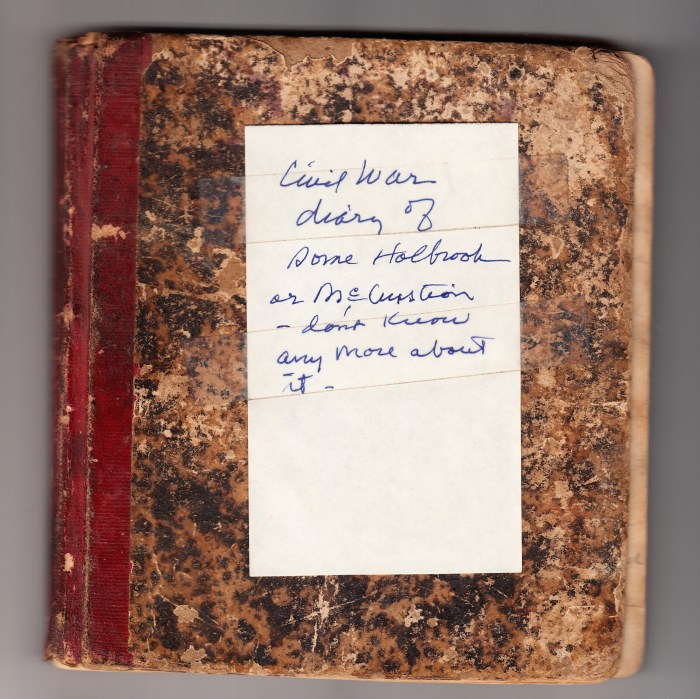
Holbrook’s diary, complete with a modern-day sticky note added by a well-meaning relative.

As Holbrook writes in his diary, a “company of nine” left that day to “join the army of the Southern Confederacy.” They called themselves the “Mt. Vernon Grays.”

Identifying your group by a geographical area and the word “Grays” was apparently a common thing for Confederate soldiers to do.

For example, my husband John’s great-great-grandfather, Lt. Col. William Henry Ramsey, was a “Pigg River Gray.” They were named for a river in Pittsylvania County, Virginia.

Gray, of course, was the color of the Confederate uniform.

So, who were Mt. Vernon Grays?

The Mt. Vernon Grays, who would join the Third Texas Cavalry’s Company H, hailed from the most prominent families in and around Titus County, Texas. In his book, “The Third Texas Cavalry in the Civil War,” author Douglas Hale describes the men of the Third Texas as “an elite minority.”

Hale writes, “Since the men provided their own horses and equipment, cavalrymen were most often drawn from those more prosperous elements of society that could afford the considerable expense involved. The men of the Third Texas were disproportionately representative of the well-to-do.”

George Stringfellow, mentioned repeatedly in Holbrook’s diary, fits this description. The 1860 U.S. Census for Hopkins County, Texas, lists Stringfellow as a 21-year-old, Alabama-born merchant with a personal estate worth more than $8,000. This translates to about $277,000 in 2016 dollars.

Holbrook also was a merchant. Another Mt. Vernon Gray, Charles Hamilton, is described in Hale’s book as “a Titus County planter’s son.”

As privileged young men, it’s likely they were not accustomed to doing what might have been considered “women’s work.”

As Holbrook writes on Aug. 5, within a week of leaving home, “…we had our first experience in washing. If some of our Mt. Vernon friends had seen us all around a tub scrubbing our dirty shirts they would no doubt have laughed heartily at our awkwardness.”

Next week, “Who were the Mt. Vernon Grays?” continues with names and a little bit about each man — at least the seven I’ve been able to identify so far. Until then.

What are Jayhawkers?

This week, I was going to write about the Mt. Vernon Grays — who were they and, best I can tell, what happened to everyone after they joined the Third Texas Cavalry in August of 1861.

I did say, however, that this would depend on how the research was going. So far, it’s gone well. I’ve discovered some neat stuff, but I’m just not ready to post this article yet.

So, this Civil War Wednesday will be about Jayhawkers.

What are Jayhawkers? Most people, particularly basketball fans, have heard of the University of Kansas Jayhawks, but according to Merriam-Webster, a Jayhawker is “a member of a band of antislavery guerrillas in Kansas and Missouri before and during the American Civil War.”

Alternatively, the online dictionary says it is “a native or resident of Kansas.”

Of course, there’s more to it than that. Other online sources say the term originated in the 1840s, and was a mash-up of two aggressive, native birds, the blue jay the sparrow hawk. The word also was used to describe people who passed through the Kansas Territory on their way to California in the late 1840s. Depending on who’s talking, being called a “Jayhawker” could be a compliment or an insult.

From 1854 to 1861, the term was used for Kansans involved in the “Bleeding Kansas” conflict, which was over whether or not Kansas would be a slave or free state.

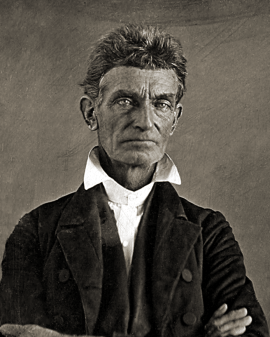
John_Brown_daguerreotype_c1856 -
John Brown. By John Bowles (1833-1900).

According to a summary on the National Parks Service website, during the Bleeding Kansas era, “murder, mayhem, destruction and psychological warfare became a code of conduct in Eastern Kansas and Western Missouri. A well-known examples of this violence was the massacre in May 1856 at Pottawatomie Creek where John Brown and his sons killed five pro-slavery advocates.”

Texas Cavalryman Columbus Williamson “C.W.” Holbrook was familiar with Jayhawkers. In his diary, he even writes about being shot by one.

Near Neosho, Missouri, on September 3, 1861, Holbrook makes the following entry:

It came my lot to stand guard to night. I was standing in the corner of a cornfield between the hours of one and two oclock when a cowardly Jayhawker slip[p]ed up on me within fifteen steps. 

I halted him but before I had the word farly out of my mouth he fired at me, hit me in the right arm just above the elbow. I fired at him with my six shooter don’t know wheather I hit him or not. He ran through the stalks lilk a wild buck and disappeard.

There is no other mention of the injury in the diary, so it must not have been that serious.

On Sept. 20, there was another mention of Jayhawkers, but this story ends quite differently:

This morning we arose as before stated at day break, considerably refreshed by the short nap and started on. We crossed spring river traveled two or three miles from camp. Stoped at an old Dutchman’s who said there were about forty Jayhawkers there the morning before and robed them of almost every thing they had. 

We were ordered by our Captain to feed our horses and eat our breakfast. We had fed our horses and unsaddled them and were all hovered over the several little fires we had kindled to boil our meat talking and laughing in fancied security from Jayhawkers and as [illegible] Taylor said, the ballance of mankind, when one of our advance guard came runing in at full spead with his hat in his hand slaping his horse at every jump said there were about sixty Jayhawkers just over the hill. 

Every man to his horse cries the Captain, saddle up! My sadelle was on the fence and my bridle tangled up generaly speaking but I managed to get it on and saddle my horse in all possiable dispatch. By this time we could see them coming over the hill. 

We mounted our horses and fell into line but was supprised to see the reported sixty make a column a half a mile long they come they come and still they come their colums stretched out across the prairie in magestic and war like display Captain Russel sent one man to learn their number and to know wheather they were friends or foes, and to our great delight they turned out to be the ballance of our regiment with Col Greer at their head who had left camp at twelve oclock to reinforce us if necessary, and had crossed the river above us and were coming down. 

I dont know how the boys felt but I know I felt better about this time than I have since I left home, and from the smiles that that were playing upon the countinence of the boys one would guess they were enjoying the same pleasant sensations.

I would imagine so!

Until next week when, hopefully, I’ll be ready to tell you more about the Mt. Vernon Grays.

Civil War Wednesday: Horrors of War

Battle_of_Wilsons_Creek
The Battle of Wilson’s Creek. Kurz and Allison, Wikimedia Commons.

In his diary, Columbus Williamson Holbrook usually avoids serious topics.

Mostly, the young merchant from Mt. Vernon, Texas, writes about everyday things, among them women and food. He also writes about people he and the Mt. Vernon Grays encountered during their journey from the Piney Woods of east Texas to Springfield, Missouri, where they would join the Third Texas Cavalry in August of 1861.

For instance, on Aug. 4, Holbrook writes, “We saw six or eight indians this morning at a spring which were a great curiosity to some of the boys.”

Holbrook also mentions people who gave them corn for their horses or invited them to dinner. I’d like to find out who these people were — Mr. Dowdy, Mr. Frank Simms, Mr. Starr, Mr. Leebough, Mr. Wilks and others. One could spend a lifetime, I imagine, addressing every little thing mentioned in Holbrook’s diary.

At some point, however, War had to rear its ugly head. This is a Civil War diary, after all.

On Aug. 12, not too far from Fayetteville, Arkansas, the Mt. Vernon Grays stop for the night on the property of a Mr. Calahan. There, Holbrook writes, “we heard the good news of the battle and glorious victory of our army at Springfield.”

The battle he writes about is Wilson’s Creek, fought on Aug. 10, 1861. It was a Confederate victory. After arriving in Springfield on Aug. 14, Holbrook jots down his observations (paragraphs added, but otherwise as written):

Today being the fifteenth day since we left home we set out early for the camp which is five miles this side of Springfield a distance of forty miles for to days travel. We did not stop to get diner or feed our horses but rolled on through the dust that had been beat up as fine as flour by army ahead

we met crowds of people going to and fro who had been to the battle field anxiously enquiring about their friends. For thirty miles along the road to Springfield there is scarcely a hous that is occupied, their finery torn down and crops distroyed, stacks of grain eaten up, houses lef open, beds and furniture scattered over the floor, yard gates torn down, ruin and devastation has spread over the land. …

We got to the battlefield about three o’clock this evening. When we got there, we met with Lieu[tenant] Conly from Capt Bryants Company, who went with us over the battlefield and showed us where the principal engagements were.

The Lincolnites buried their dead for three days, but when we got there four days after the battle there were plenty of dead Dutch upon the field, which presented quite a gastly specticle to see poor human beings left dead upon the sod, uncared for but by the ugly fowls that eat their flesh. …

Next week — perhaps two weeks from now, depending on how the research goes — I’ll try to answer the question, “Who were the Mt. Vernon Grays?”

In addition to the diary, I’ve been studying Holbrook’s company roster, the census and other public records to try to determine who these nine young men were. It’s not the easiest question to answer, without benefit of a time machine, but I’ll do my best.

Until next time.

Civil War Wednesday: Women and Food

As I transcribed the Civil War diary of Columbus Williamson Holbrook, a distant uncle-in-law of my husband, John, I noticed the timelessness of it. Although it was written 155 years ago, much of what Holbrook writes could have been written in 2016.

first entry-blog cropped
A portion of Holbrook’s first diary entry

As Holbrook wrote in his first entry, he and the Mt. Vernon Grays left “fathers, mothers, brothers and sisters and numerous near and dear friends.” No wives are mentioned (although there might have been at least one, which I’ll address in a future post).

It’s safe to say these were young Texans, off on an adventure — as Holbrook put it, “to join the army of the Southern Confederacy.”

Perhaps it’s not surprising then, that much of what Holbrook wrote about concerned women and food. I’ve pulled a few sentences from the diary on these topics. Note: for the most part, I’ve left the entries as written, with spelling and punctuation errors.

On women:

August 1: …Before we got to Clarksville T.B. Turner and myself called by to see some female friends …

Aug 11: … passed over the boston mountains and on the top of the mountain we met three grand ladies going to church two of whom had their shoes in their hands walking barefoot over the rocks. I suppose they intended to put them on before they got to church …

Aug 18: … had the pleasure of seeing some of the Missouri girls to day and five of them attended church. They look good, but poorly compare with the ladies at home.

Aug 22: … had the excruciating pleasure of being placed on guard. I have now come to the conclusion that soldiers should be paid well, honored highly and get the prettiest women in the land for wives.

Sept 1: … We were visited this evening by ten or fifteen well grown Missouri girls.

Sept 9: … All were buisly engaged yesterday and till a late hour last night writing letters. No doubt there were many aerial flights and expressions of love pened to the fair bright eyed Ladies of Texas by the way-worn home-sick lovers of this regiment. If they were all collected and published they would furnish a volumn with as much variety and mirth as Maj Jones Courtship.

While transcribing Holbrook’s diary, there were lots of things I had to Google, among them, “Major Jones’s Courtship.” A popular novel of the day, it first published in 1843 and written by William Tappan Thompson.

It’s evident from this book reference and his writing in general — however bad the spelling and punctuation — that Holbrook was an educated man.

After reading this entry, I also had to find out what “tipped our beavers” meant:

Sept 18: … heard the soft notes of a piano up the street and after taking a little Missouri peach brandy a friend of mine and myself called at the young Ladies door, tip[p]ed our beavers and walked in. Had some fine music by the lady, who was a fifteen year old girl but very talkative. The excitement caused by the young Lady, the music or the brandy, I wont say which, had some effect on my legs and head and oiled the runing … of my tongue.

After (carefully, nervously) Googling the phrase, I discovered that hats in that time period were made of beaver fur, thus, the men tipped their hats upon meeting the young lady.

Sept 22: …We were visited in camp to day by several very nice Ladies they all seem anxious to bestow any favor on us that they can I record it to their praise that the Ladis Missouri seem more zelius in the cause of liberty than the men.

[Sept] 25: … I have been in town almost all day took diner at the Hotel with my friend [A.G.] Hargrove we sasshaed around town generally and called on Miss Muller and had some fine music, for Missouri.

Civil War mess cart
Drawing of a Civil War mess cart

On food:

Aug 5: … got a supply of Bacon and some fresh buiscuit. …

Aug 6: We left camp this morning very early traveled over some rough rocky road got a birds eye view of the Ozark Mountins … found some good watermelons the owner of which was patriotic enough to charge us fifteen cents a piece. The citizens in this portion of the county would have you believe they are very patriotic, but they love to charge too well to suit me. …

Aug 9: … We staid in town all night, took supper and breakfast with Mr. Trotter it being a good place …

Aug 13: This morning, we were so anxious to go on we left without our breakfast and traveled eight or ten miles and made some coffee to refresh us and on we went again. …

Aug 20: … When diner time came, we found we had no flower. We boiled some beef and made some rosting ear soup and digned bountifully on the same without bread. … At supper, fortunately we got a little corn meal and Irish potatoes accidentally.

Aug 23: … After breakfast, Capt [Jonathan] Russel myself and ten others went out in the county foraging. We got two waggen loads of old corn some fine apples and had the unusial pleasure of digning at the table of a true Secessionist. We had a good county diner and all eat heartily of the snaps & Bacon potatoes & fried corn stewed apples and apple pies and honey and other rare dainties. …

Aug 26: This day was Tuesday but nothing of note occured except that we did not have much to eat.

Aug 28: … fine to day plenty to eat such as it is corn bread beef and coffee is the only three articles we have in our pantry …

Sept 12: This is a very drizzly unpleasant day. I got back to camp this evening about four oclock, found nothing to eat at my mess looked around among the other messes and finally found some cold bread and molasses and made a hearty diner out of it. …

Sept 13:  … Nothing occured to day worthy of note except the arival of a hoghead of sugar and two bbl [barrells] of whisky … We have not had the opportunity of sampling the whisky and dont know wheather we will or not.

Sept 14: … [George] Stringfellow and myself cooked we made a peach pie, washed up the tin pans, had some good buiscuit and some beef hash and coffee with sugar in it. Asked Capt Russel to dign with us. We had a sumptious repast. It is laughable sometimes to see the boys guarding over there rashings and dividing the forage. Some allwais sware that someone has more than he has.

Sept 22: …Our mess had a fine diner today had beans the first time I have had the pleasure of eating this favorible vegetable since I left home. …

Sept 24: … took diner with Dr. Bradford, by invitation who is a good Secessionist and is a very clever Gentleman. His good Lady prepared us the best diner we have had the good fortune to partake of since we have been in Missouri and gave us a pressing invitation to come back again.

Oct 2: … Orderly [Harry] Height came in from an excursion in the country to day and brought with him three or four chickens. The boys alwais say they buy them, but the supposition is they press them.

Perplexed by Holbrook’s use of the word “press,” I did a little Googling and discovered that the young men of the Third Texas Cavalry, Company H, probably stole the chickens. Again, the diary proves itself timeless. Boys will be boys.

Next week, we’ll shift gears to the more serious subject of war and its horrors, and what Holbrook had to say about that. Until then.

Civil War Wednesday: ‘Go bravely go’

On July 31, 1861, Columbus Williamson Holbrook — “C.W.” to family and friends — left the little town of Mt. Vernon, in the piney woods of east Texas, with a small group of young, local men. They called themselves the “Mt. Vernon Grays.”

The Grays were headed to Springfield, Missouri, almost 400 miles away. There, they would rendezvous with the Third Texas Cavalry, which was readying for battle at Wilson’s Creek. Holbrook, then a merchant in his mid-20s, would join Company H. So would his friend, George Stringfellow, a merchant from neighboring Hopkins County.

Upon leaving home, Holbrook wrote in his diary:

On the 31 day of July 1861 our Little company of nine left our lovely homes in the town of Mt. Vernon, Titus Co., Texas, tore ourselves from our Fathers, Mothers, Brothers, and Sisters and numerous near and dear friends to join the army of the Southern Confederacy.

In “The Third Texas Cavalry in the Civil War,” author Douglas Hale, professor emeritus of history at Oklahoma State University, writes, “In each case, the departure of the local company from its little hometown was attended by a huge assemblage of well-wishers: patriotic speeches, the formal presentation of a company ensign, and frequently a barbecue formed the program.”

From Holbrook’s description, the same might be said of Mt. Vernon:

We left Mt. Vernon at 10 oclock A.M. amid one of the most affecting senes I ever saw. We left as cheerfully as the circumstances would admit of, and to disipate the deep gloom that hung over us we laughed and talked all the evening, and a passer by would not observed anything gloomy in our company this evening. We marched about seventeen miles to day and camped near Trents crossing … at a very beautiful lake where we had a fine time. The band gave us music till midnight when we placed our blankets on the grass and tried to sleep, but there was not much sleep for us thinking of our weeping family that was left behind and the long twelve months before we could see them again.

Holbrook must have been well-liked in Mt. Vernon, a town that in 1861 had only about 200 residents. Before he rode out of town that morning, friends penned patriotic farewell letters in the diary.

One eloquent missive was written by Mollie Mann, a schoolteacher and a member of the town’s prominent Fanning family:

Mollie Mann Letter1-cropped
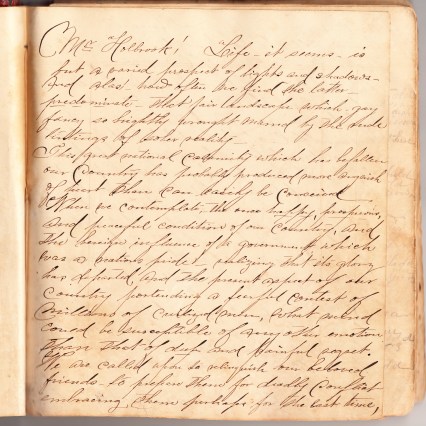
Mollie Mann’s letter to C.W. Holbrook

C.W. Holbrook: Life — it seems — is but a varied prospect of lights and shadows — and alas! — how often we find the latter predominate — that fair landscape which gay fancy so brightly wrought marred by the rude listings of sober reality. This great national calamity which has befallen our country has probably produced more anguish of heart than can easily be conceived. When we contemplate the once happy, prosperous and peaceful condition of our country, and the benign influence of the government which was a nation’s pride — realizing that its glory has departed and the present aspect of our country portending a fearful contest of millions of civilized men, what mind could be susceptible of any other emotion than that of deep and painful regret. We are called upon to relinquish our beloved friends — to prepare them for deadly conflict — embracing them perhaps for the last time, as they wave us a long, sad farewell — leaving us all the heart holds dear and hasten to the scene of carnage. But believing that we have Divine approval in the cause you espouse, we bid you go. And tho we are not unmindful of the hardships and perils of a soldier’s life — this is no time for frail hearts — this is a period for heroes, for hearts brave and true, and while you are the objects of our tenderest sympathies and most fervent prayers — remember that Liberty is the sweetest boon of life and dearer far — that we would rather weep over a soldier’s grave, than dwell under the oppressor’s sway. Then, go bravely go, and teach the cowards how to claim our rights and pervert our liberties, and may you happily survive the conflict. “Your honor calls you hence, then go and all the gods go with you, upon your sword sit laurel victory and smooth success be strewed before your feet.”

This farewell letter was written by another friend, E.G. Patton:

Mr. Holbrook! Goodbye, for a few days past we have been deeply interested in your contemplated departure and now as the last privilege of expiring friendship, I am requested to subscribe myself in your journal among the favored ones you cherish as friends. You go to participate in the unhappy crisis of the day — and tho’ you have our fondest wishes and our never ceasing rememberance, we will not cloud your departure with regrets. But bid you go — go join the brave valiant Sons of the South and nobly defend our rights. We bid you Heavenly smiles and a joyous return to your cherished home and much loved friends you now bid adieu.

After leaving Mt. Vernon, Holbrook wrote about how the Grays were received in towns they passed through on their way to Springfield:

Aug 1: … When we marched into town, we were cordially received by the good Citizens of the place, every one wanting to do us some favor. We were conducted out of town by Mr. Frank Simms whose kindness of himself and family [will] long be remembered by our little company. We had a very pressing invitation to attend a dansing party to night but declined.

Aug 6: … found some good watermelons, the owner of which was patriotic enough to charge fifteen cents a piece. The citizens in this portion of the count[r]y would have you believe they are very patriotic but they love to charge too well to suit me. We traveled sixteen miles in the fore noon today, got our din[n]er and fed our horses at Mr. McDanels spring, had some fine buiscuits baked, eat heartily and some of the boys took a snoose in the after noon. We traveled fifteen miles and camped out at Mr. Lanes when Georg Stringfellow was a little sick. Mr. Lane had two son in laws to the war. We saw their wives. They showed us their husbands daguerreotypes and said they were man enough to fight themselves.

Next week, we’ll see that Holbrook, a typical young man (even by today’s standards), spent a lot of time thinking about two things: food and women. Until then.

Visiting ‘The Maier’

Today, I visited the Maier Museum of Art.

It’s only a few miles from my home, in the Rivermont historic district. The museum is owned by Randolph College, which was founded as Randolph-Macon Woman’s College in 1891. My mother-in-law, Mary Wells Ramsey (then Ridley), went there in the 1960s.

Maier Front
The Maier Museum of Art

“The Maier,” as it’s known around town, has an interesting history. It was built 1951, during the Cold War, as a safe repository for works from the National Gallery of Art, should they need to be evacuated from Washington, D.C.

The arrangement was called “Project Y” and continued officially until 2001. In return, the college (and those of us who live in Lynchburg) got a great little art museum.

The Maier specializes in American art of the 19th, 20th and 21st centuries. Admission is free, which is pretty great, considering the quality of the art hanging inside. My favorite piece is “Through the Arroyo,” by E. Martin Hennings, which also has an interesting history at the Maier.

Among many well-known artists, the Maier’s collection also includes work by Thomas Hart Benton, Edward Hopper and Georgia O’Keeffe.

O’Keeffe’s “Yellow Cactus” is another of my favorites at the Maier. My sister, Theresa, gave me a paperweight with Yellow Cactus on it. I’ve also been to the Georgia O’Keeffe Museum in Santa Fe, New Mexico, several times.

And, there’s a poster of O’Keeffe, sitting astride a motorcycle in 1944, on the wall of my office. Yes, I’m a fan — not only of O’Keeffe’s art but of the way she lived on her own terms. She also got to live in New Mexico, which makes me a little jealous.

Georgia O'Keeffe & Mary Wells Ridley - 1967
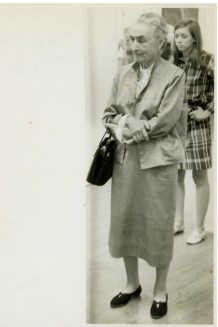
Georgia O’Keeffe looks at my mother-in-law’s painting, 1967.

In 1967, O’Keeffe visited Randolph-Macon Woman’s College to receive an honorary degree. At the same time, my mother-in-law was a senior art major, and her work was being exhibited in a student show at the Maier.

In this photo (right), Georgia O’Keeffe looks at my mother-in-law’s painting, as my mother-in-law looks on. I can only imagine what both were thinking at the time.

According to O’Keeffe’s bio on the Maier’s website, the famous artist spent some of her childhood in Chatham, Virginia, which is about an hour south of Lynchburg.

Soon, John and I will travel to Chatham’s Pittsylvania County Courthouse, where we’ll look for records pertaining to both of our families.

John’s dad’s family was in Pittsylvania County from the 1700s well into the 20th century, while my mother’s family migrated through the area from eastern Virginia in the late-1700/early-1800s, en route to Southeastern Kentucky.

I wonder if any of our kinfolk married each other. I’ll let you know if they did.

The Civil War Diary

About 12 years ago, John and I were at his grandma’s house in Cookeville, Tennessee. The grandchildren all called her “Dearmom,” although no one’s quite sure why. Regardless she was Dearmom to everyone, including me.

Front Cover - cropped
The diary of C.W. Holbrook

During that visit, we were in Dearmom’s basement, looking through boxes of stuff that had belonged to John’s late-grandpa, Bromfield Ridley. Brom, as he was called, was a character. Among his many quirks was that he wrote his name on everything — books, tools, whatever belonged to him — in black magic marker.

Brom also flew cargo planes in North Africa in World War II, was a college biology professor and once went fishing with football legend Terry Bradshaw.

While going through boxes, one of us came across a tattered book with one of those old, marbled covers. It was literally falling apart. Affixed to the front of it was yellow sticky note that said this: “Civil War diary of some Holbrook or McCuistion — don’t know any more about it.”

Turns out, the diary was written during the summer and fall of 1861 by Columbus Williamson Holbrook, of Mt. Vernon, Texas. John’s grandpa’s older sister, Mary Wells, had married a Holbrook, although not until the 1900s.

The diary passed down through the Holbrook family, then to Mary Wells and her husband, and finally to John’s grandparents. Because John and I are interested in history, Dearmom gave it to us.

The diary sat around our house for about 10 years in a gallon-sized baggy. That is not a good way to store a paper document, by the way, but regardless, there it sat on a shelf in the office.

Over the years, one or the other of us opened the diary a few times, but the writing was mostly in pencil and very faded and difficult to read. It wasn’t until about two years ago that I decided to transcribe the diary from beginning to end.

Like I said, it was in terrible shape. Some pages were falling out. There were moldy spots and some rips and holes. I don’t imagine my handling of it did it any favors in the end, but the thought of being perhaps the only person who had ever read the entire thing was too enticing to resist. What secrets would I discover inside?

So over the summer of 2014, sometimes using a magnifying glass, I transcribed C.W. Holbrook’s diary. The first entry, after a listing of Holbrook family members, is written by Holbrook’s younger brother, William Walter Scott Holbrook:

Mr. C.W. Holbrook

My dear brother that fell a victim in the war. He is gone to his eternal abode where there is piece, joy and happiness throughout the endless ages of eternity. Your brother.

W.S. Holbrook

I don’t know exactly when William Walter Scott Holbrook penned this sweet eulogy to his brother. The 1860 U.S. Census for Titus County, Texas, lists W.W.S. Holbrook as a 2 year old, so it’s likely the entry was written much later than his brother’s death, which is said to have occurred sometime in 1862.

It’s possible the younger Holbrook didn’t even remember his brother, but wrote the entry based on what he was told by other family members.

Soon, I’ll post eloquent farewell letters, written in Holbrook’s diary by his neighbors and friends. But I guess that’s enough for now. Until later…